Email: info@boninscaffolding.com
WhatsApp: +86 136 4619 6162
Email: info@boninscaffolding.com
WhatsApp: +86 136 4619 6162

Email: info@boninscaffolding.com
WhatsApp: +86 136 4619 6162

Ringlock and Cuplock are the two system scaffolds most export buyers compare first — and the comparison is often made badly. Both are modular steel systems, both are used for access, support and formwork, and both are covered by EN 12810 / EN 12811. The real difference is not which one is “better”. It is how each system connects at the node, and what that connection lets you build.
This ringlock vs cuplock scaffolding guide compares the two systems the way a buyer should: node design, geometry, components, erection, and the kind of project each one fits — using Bonin’s published product specifications, not catalogue claims. Where a number is not published, this guide says so instead of filling it in.
| Ringlock | Cuplock | |
|---|---|---|
| Node | Rosette (ring) welded to the standard, with 8 holes | Fixed bottom cup and sliding top cup on the standard |
| Connections at one node | Up to 8 directions | Typically 4 directions |
| Angles | 90° and 45° | Mainly right angles |
| Standard tube | 60.0 mm / 48.3 mm, Q235/Q345 | 48.3 × 3.2 mm, Q235/Q345 |
| Node spacing | Rosette spacing usually 500 mm | Cup spacing typically 500 mm |
| Ledger tube | 48.3 × 3.2 mm (Q355) or 48.3 × 2.5 mm (Q235) | 48.3 × 3.0 mm, Q235, forged blade ends |
| Best fit | Complex, large and high-rise projects; irregular layouts | Repetitive, regular, small to medium projects |
| Standards listed | EN 12810 / EN 12811, BS 1139 | EN 12810 / EN 12811 (system level) |
If your project is a straightforward rectangular facade repeated floor after floor, the table already points one way. If it is curved, stepped, or full of openings and cantilevers, it points the other. The sections below explain why.
A Ringlock standard carries a rosette — a flat steel ring welded to the tube at regular intervals, usually every 500 mm. Each rosette has 8 holes. A ledger ends in a wedge head that slots into a hole and is locked with a hammer blow. Because the holes are spaced around the ring, ledgers and diagonals can connect at 90° and at 45°, in up to 8 directions from a single node.
That geometry is the whole point of Ringlock. It lets one bay turn a corner, step around an opening, or brace diagonally without a separate fitting. For high-rise facades, industrial plants, bridges and other irregular structures, that flexibility saves a large amount of loose couplers and on-site improvisation.
Bonin’s Ringlock components, as listed on the product pages:
Two details are worth checking on any Ringlock order. First, rosette thickness: Bonin lists 6–10 mm, and the thickness, the weld to the tube, and the hole spacing decide how cleanly the wedge locks. Second, the ledger grade: Q355 and Q235 ledgers are not interchangeable in specification, so the quotation should state which grade is being supplied, not just the tube size.

Cuplock works differently. Each standard carries a fixed bottom cup, and a sliding top cup drops over the ledger’s blade ends and locks them in place. The connection is fast — drop the cup, tap it home — and there are fewer loose parts to lose on site.
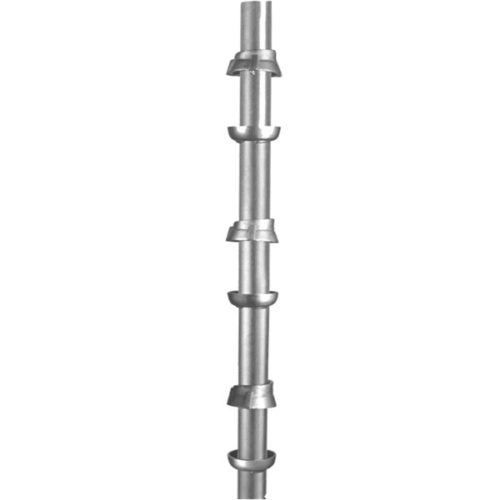
The trade-off is geometry. A Cuplock node typically takes 4 directions, mainly at right angles. For regular, repetitive work — a standard facade, a slab support grid, a warehouse or residential block — that is all the geometry the job needs, and the system’s speed and simplicity are real advantages. For an irregular layout, the same limitation means more adaptation, more loose fittings, or a different system.
Bonin’s Cuplock components, as listed on the product pages:
The part to inspect on a Cuplock order is the cup and blade fit: the top cup must slide freely and lock the blade ends firmly, with no play that lets a ledger work loose. Ask for a close-up photo of the cup and blade end from a production batch, not only a sample.
Geometry and flexibility. Ringlock wins on irregular work. Eight directions per node and 45° connections let it follow curves, steps and openings. Cuplock wins on regular work, where right angles and repetition are the whole job.
Erection speed and parts count. Cuplock is the faster system on a repetitive grid: fewer parts per node, a simple drop-and-lock action, and less to carry. Ringlock takes more connections per node, but it replaces loose couplers and makeshift bracing that an irregular Cuplock layout would need anyway. Compare speed on your layout, not in the abstract.
Component range. Ringlock’s range is broader because the rosette accepts ledgers, diagonals and brackets at more angles. Cuplock’s range is narrower and more standardised, which is an advantage for stockholding: a rental company or distributor can hold fewer SKUs and still cover most jobs.
Load capacity. This is the question buyers ask first and the one this guide will not answer with a made-up table. Neither system’s product pages publish load numbers — only qualitative statements about high load-bearing capacity. Load capacity depends on the standard height, ledger length, bracing, base condition and the grade actually supplied. Ask the manufacturer for a load table by height and bay size, and for the test report or certificate behind it. Any supplier who quotes a single capacity figure with no height next to it has not answered the question.
Cost. Do not compare the price of a single standard. Compare the price of a complete bay for your layout, including ledgers, diagonals, base jacks, boards and the fittings each system still needs. Cuplock often looks cheaper per piece on a regular job; Ringlock often works out cheaper per completed irregular bay, because it needs fewer additional parts.

No — not as a single connected structure. Their nodes are different, so a Ringlock ledger does not lock into a Cuplock cup and vice versa. Use one system per scaffold and confirm compatibility before ordering accessories.
There is no honest single answer. Strength depends on height, bay size, bracing and the grade supplied. Ask for the load table at your working height and the test report behind it, for the system and configuration you will actually build.
Per piece, Cuplock is often lower on a regular job; per completed bay, Ringlock can be lower on an irregular job because it needs fewer extra fittings. Compare a priced bill of materials for your layout, not a single component price.
Cuplock is faster on repetitive, right-angled work. Ringlock is faster overall on complex layouts, because its node replaces loose couplers and improvised bracing. The right comparison is erection time for your scaffold, not for one node.
Choose the node first and the components follow. If the project is regular, repetitive and right-angled, Cuplock’s speed and simplicity are hard to beat. If it is large, high, curved or irregular, Ringlock’s eight-direction rosette earns its place. Either way, get the grade, the node dimensions, the finish and the load table in writing before the order is placed — those four confirmations decide whether the system performs as specified, whatever the catalogue says.
Bonin Scaffolding manufactures both Ringlock and Cuplock system components in Nantong, Jiangsu, for distributors, contractors and importers, with OEM/ODM support and factory-direct export pricing. Send your layout, heights, bay sizes and standards requirements to get a quotation for the system that fits your project.
Related reading: How to Choose Heavy Duty Adjustable Steel Props: Size, Load Capacity and Finish
